

Modern enterprises generate more information than ever before, yet understanding the business has never been harder. This paper introduces Context Debt, a new management concept that explains why fragmented business context has become one of the biggest hidden barriers to enterprise productivity, decision-making, and AI.
Download this executive paper to discover why the next challenge in enterprise architecture is no longer creating more information. It is preserving the understanding that gives information meaning.
Context Debt does not appear overnight. It accumulates gradually as organizations grow, making everyday work slower, more fragmented, and increasingly dependent on manual effort.
These are not isolated operational issues. They are the recurring interest payments of fragmented business context.
Introducing Context Debt as a framework for understanding the hidden operational costs of fragmented business context.
A look at the disconnect between how businesses think about entities and how enterprise software organizes their information.
Why information alone is not enough, and how relationships and history transform it into meaningful business context.
How four forms of fragmentation, System, Organization, Knowledge, and Time, contribute to Context Debt.
AI can magnify the effects of fragmented business context, making context quality increasingly important.
Why organizing information around business entities may represent the next evolution of enterprise information architecture.
Written for leaders responsible for how information flows, decisions are made, and work scales across the enterprise.
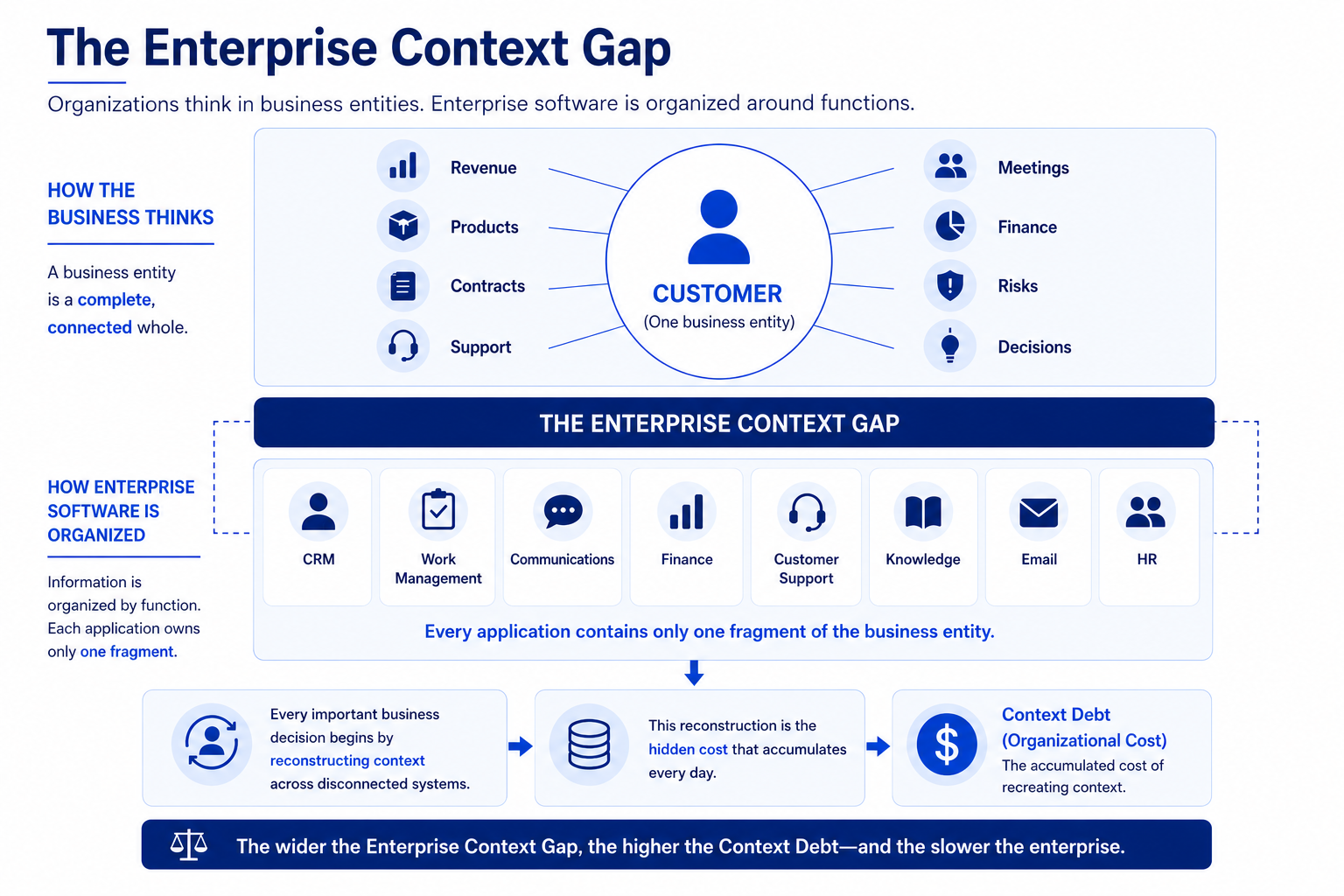
This framework shows how enterprise software fragments business entities across specialized applications and why reconnecting that understanding has become one of the defining productivity challenges of modern organizations.
The Context Papers is a thought leadership series exploring how enterprise information architecture must evolve for the AI era. Each paper introduces a foundational concept that builds toward a new framework for reducing enterprise friction, preserving business understanding, and enabling organizational intelligence.
Context Debt
Context Architecture
The Information Nervous System
Organizational Intelligence
Entity-Centric Organizations
Download